Baccarat has a reputation for glamour and complexity, but the mechanics are almost absurdly simple: you pick one of three outcomes, the cards do the rest, and you never make another decision. What makes it worth understanding is the spread between the bets — the Banker wager is one of the best deals in the building, while the Tie bet is one of the worst. Knowing the difference is the whole game. To explore it hands-on, see the live interactive baccarat guide. For how baccarat stacks up against everything else, see the Game Guides index.
Baccarat is pure chance with no player decisions after the bet. You pick Banker, Player, or Tie, and the cards determine the rest. The Banker bet has a 1.06% house edge after commission; the Player bet, 1.24%. Both are among the best odds in the casino. The Tie bet has a 14.4% edge. The only decision that matters is which bet you place.
How the game works
Two hands are dealt each round — Player and Banker. These are just the names of the positions, not actual people, and betting on Banker doesn’t mean you’re backing the house. Card values run a little differently from most games:
| Cards | Value |
|---|---|
| 2 through 9 | Face value |
| 10, J, Q, K | 0 (worth nothing) |
| Ace | 1 |
Only the last digit of the total counts. A 7 plus an 8 is 15, which counts as 5. A 4 plus a 6 is 10, which counts as 0. The best possible hand is 9. Here’s how a round plays out:
- Place your bet. Banker, Player, or Tie. That’s your only decision in the entire game.
- Two hands are dealt. Two cards each to the Player and Banker positions.
- Check for a natural. If either hand totals 8 or 9, it’s a natural — the round ends immediately and the natural wins.
- Apply the third-card rules. If neither hand has a natural, fixed rules decide whether each draws a third card. Nobody chooses — it’s automatic.
- Compare and pay. The hand closest to 9 wins. Banker pays 1:1 minus 5%; Player pays 1:1; Tie pays 8:1 (or 9:1 at some tables).
Why the Banker has the edge
You never need to memorize the third-card rules — the dealer runs them. But they’re the reason the Banker hand wins slightly more often. The Player hand draws on a total of 0–5 and stands on 6–7. The Banker hand’s rules are more involved, drawing or standing based on the Player’s third card. Those rules give the Banker a small statistical edge — which is exactly why a winning Banker bet pays a commission. The house is simply pricing in the Banker’s better odds.
Bet types
Three main bets, and the math between them isn’t close.
| Bet | What it means | Payout | House edge |
|---|---|---|---|
| Banker | The Banker hand finishes closer to 9. | 1:1 minus 5% commission | 1.06% |
| Player | The Player hand finishes closer to 9. | 1:1 (no commission) | 1.24% |
| Tie | Both hands finish on the same total. | 8:1 (some tables 9:1) | 14.4% |
Side bets
Many tables offer side bets — Banker Pair, Player Pair, Big, Small, and others. They carry dramatically higher house edges than the main bets. The game’s reputation for good odds applies to Banker and Player, not to everything on the felt.
| Common side bet | Typical house edge |
|---|---|
| Banker Pair | ~10.4% |
| Player Pair | ~10.4% |
| Either Pair | ~14.1% |
Variants
| Variant | Key difference |
|---|---|
| Punto banco | The standard version worldwide. Fully automatic — no player decisions after the bet. This is the version described here. |
| Mini baccarat | Same rules and odds, smaller table, lower minimums, faster pace. The dealer handles all the cards. |
| Chemin de fer | Players take turns as Banker and make drawing decisions. Rare outside European casinos. |
| No-commission | Drops the 5% Banker commission but modifies payouts (a Banker win on 6 pays 0.50:1). Check the edge — usually similar or slightly worse. |
The math
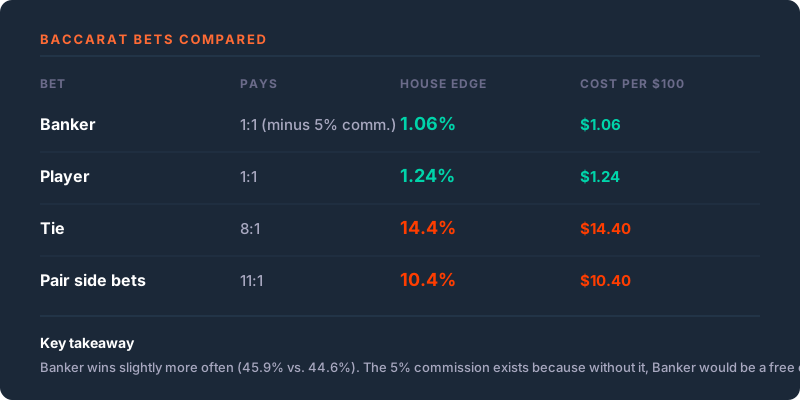
Same table, same game, wildly different odds depending on the bet. The Banker and Player bets are where the math works in your favor (relatively); the Tie bet is where it turns against you.
House edge by bet
| Bet | House edge | Why |
|---|---|---|
| Banker | 1.06% | Wins about 50.68% of decided hands thanks to the third-card rules. The 5% commission on wins brings the effective edge to 1.06%. |
| Player | 1.24% | Wins 49.32% of decided hands. No commission, but the lower win rate produces a slightly higher edge. |
| Tie | 14.4% | Ties land about 9.5% of the time. The 8:1 payout implies 11.1%. That gap is the house edge. |
What this means for your wallet: a Banker bet costs about $1.06 per $100 over time, a Player bet about $1.24. A Tie bet costs about $14.40 — roughly thirteen times worse, in the same game.
When a tie occurs and you’ve bet Banker or Player, your bet is returned — it’s a push, not a loss. The house-edge figures above already account for this, so a tie never takes your main wager.
Key terms
- Natural
- A hand totaling 8 or 9 on the first two cards. The round ends immediately, and the natural wins unless the other hand also has one of equal or higher value.
- Banker / Player
- The names of the two hands dealt each round — table positions, not real people. Betting on “Banker” doesn’t mean you’re backing the house.
- Commission (vig)
- The 5% fee taken from winning Banker bets. It exists because the Banker hand wins slightly more often, thanks to the third-card rules.
- Third-card rule
- The fixed set of rules that decides whether each hand draws a third card. The dealer handles it automatically — no one makes a choice.
- Scorecard
- The paper card many players use to track results. Every table provides one. It records history but predicts nothing — each hand is independent.
- Shoe
- The dealing device holding multiple decks (usually 6 or 8), shuffled and cut before play begins.
Tips for informed play
- The Banker bet has the best odds on the table. At 1.06% it’s one of the lowest edges in the casino. The 5% commission sounds annoying, but it’s already baked into that number — and Banker still beats Player.
- Skip the Tie bet. The 8:1 payout looks tempting; the 14.4% edge isn’t. You’d need ties to land about 11% of the time to break even, and they hit about 9.5%. The math doesn’t work.
- Scorecards are for tracking, not predicting. Every table provides them and many players hunt for patterns. Each hand is dealt independently — past results don’t influence the next one. Track it if you enjoy it, but know it’s entertainment, not information.
- Watch the side bets. Pair bets and Big/Small run 10–15% or more. The main game’s great odds don’t extend to them.
- Set your session budget. At a moderate 40–80 hands per hour and $25 a hand, that’s $1,000–$2,000 an hour in total wagers. Decide what the session is worth before the first hand.
Common myths
“Banker is on a streak — bet it again.”
Each hand is independent. Banker wins about 50.68% of decided hands whether it just won seven straight or lost seven straight. Streaks feel meaningful; statistically they’re just random clustering.
“The scorecard reveals a pattern.”
Tables hand out scorecards and show recent results on a screen. They record history, not the future. The last seven hands have a 0% effect on hand number eight.
“No-commission tables are a better deal.”
Dropping the 5% commission sounds like a win, but those tables compensate with modified payouts — a Banker win on 6 paying half. Check the actual house edge; it’s usually similar or slightly worse.
Bet Banker, skip the Tie, ignore the scorecard. Baccarat gives you exactly one decision — make that one well and you’re playing some of the best odds in the casino.