Craps looks intimidating: a crowded table, a sprawling layout, a dozen people shouting at dice. Underneath the noise it's simple, and it hides a genuinely remarkable bet. This guide covers the structure of a round, every bet worth knowing, and why a thin strip behind the pass line is the fairest wager in the building. You can also work through it in the live interactive craps guide. For the full set of games, see the Game Guides index.
One player (the shooter) rolls two dice and everyone bets on the outcome. The core bet — the pass line — has a 1.41% house edge, one of the lowest around. After a point is set, you can back it with an "odds bet" that pays true odds at 0% house edge — the only wager in the casino with no built-in margin. Stick to pass line plus odds, and skip the proposition bets in the center of the table (9–16%+ edge).
How the game works
Craps is played with two dice. One player — the shooter — throws them, and everyone at the table bets on the result. Each round has two phases: the come-out roll, then the point phase.
The come-out roll
The first roll of a new round is the come-out roll. Three things can happen:
| Result | Numbers | What happens |
|---|---|---|
| Natural | 7 or 11 | Pass line wins. Round over. |
| Craps | 2, 3, or 12 | Pass line loses. Round over. |
| Point | 4, 5, 6, 8, 9, or 10 | That number becomes "the point." The round continues. |
The point phase
Once a point is set, the shooter keeps rolling until one of two things happens: they hit the point (roll that number again — pass line wins, new round begins), or they seven out (roll a 7 — pass line loses, dice pass to the next shooter). That's the entire structure: come-out roll, point set, roll until the point or a 7, repeat.
Two dice produce 36 possible outcomes, and six of them make a 7 — more than any other number (a 16.67% chance, every roll). That's why 7 is your best friend on the come-out and your worst enemy during the point phase, and why "seven out" ends the round: it's simply the most likely result.
Bet types
Pass line, don't pass, and odds
The pass line is the foundation: 1.41% house edge. Don't pass bets against the shooter at a slightly lower 1.36% — mathematically the better bet, though some players avoid it socially because it means betting against the table. Come and don't come work identically but start after a point is already set, giving you your own personal come-out roll.
The real prize is the odds bet. After a point is established, you can place an additional wager behind your line bet that pays at true mathematical odds with zero house edge — the best bet in the entire casino.
| Point | True odds (pass) | True odds (don’t pass) |
|---|---|---|
| 4 or 10 | 2:1 | 1:2 |
| 5 or 9 | 3:2 | 2:3 |
| 6 or 8 | 6:5 | 5:6 |
Casinos cap odds bets at a multiple of your line bet — typically 3x, 4x, or 5x, sometimes 10x or even 100x. The higher the multiple you're allowed (and willing) to bet, the lower your effective house edge becomes.
Place bets
A bet that a specific number rolls before a 7. Two of them are reasonable; the rest get expensive fast.
| Number | Payout | House edge |
|---|---|---|
| 6 or 8 | 7:6 | 1.52% |
| 5 or 9 | 7:5 | 4.00% |
| 4 or 10 | 9:5 | 6.67% |
Proposition bets (the center of the table)
The flashy bets in the middle of the layout. High payouts, massive house edges — this is where the casino makes its money on craps.
| Bet | Payout | House edge |
|---|---|---|
| Any 7 | 4:1 | 16.67% |
| Any craps (2, 3, or 12) | 7:1 | 11.11% |
| Hard 6 / Hard 8 | 9:1 | 9.09% |
| Hard 4 / Hard 10 | 7:1 | 11.11% |
| Yo (11) | 15:1 | 11.11% |
| Snake eyes (2) / Boxcars (12) | 30:1 | 13.89% |
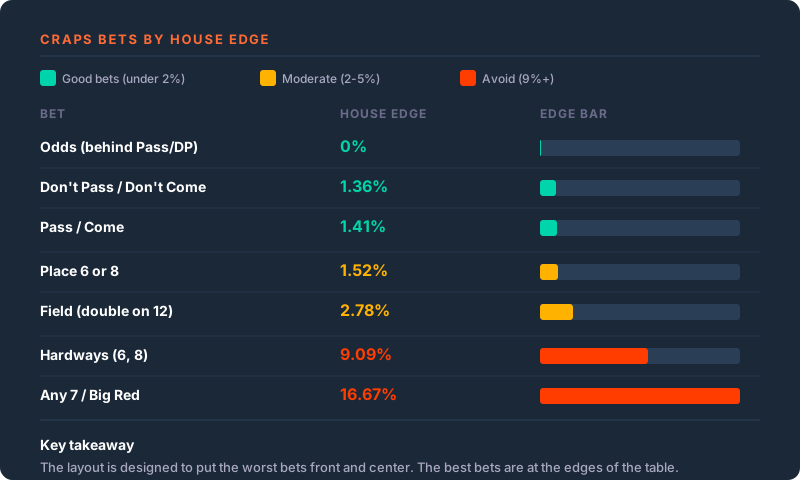
The math: why odds bets are unique
Every bet in craps carries a house edge except one. The odds bet pays true mathematical odds with no house margin, so pairing it with a pass line bet dilutes your overall edge — and the more you put in odds relative to the line, the closer your effective edge drifts toward zero.
| Bet | House edge | Verdict |
|---|---|---|
| Odds bet (behind pass / don’t pass) | 0% | The only fair bet in the casino |
| Don’t pass / Don’t come | 1.36% | Best base bet |
| Pass / Come | 1.41% | Standard starting bet |
| Place 6 / 8 | 1.52% | Reasonable |
| Place 5 / 9 | 4.00% | Elevated |
| Place 4 / 10 | 6.67% | Expensive |
| Hard 6 / 8 | 9.09% | Skip it |
| Any craps | 11.11% | Skip it |
| Any 7 | 16.67% | The worst bet on the table |
How odds shrink your effective edge
Starting from a $5 pass line bet, watch what backing it with odds does to the combined house edge:
| Pass line bet | Odds multiple | Effective house edge |
|---|---|---|
| $5 | No odds | 1.41% |
| $5 + $5 odds | 1x | 0.85% |
| $5 + $10 odds | 2x | 0.61% |
| $5 + $25 odds | 5x | 0.33% |
| $5 + $50 odds | 10x | 0.18% |
With a pass line bet only, you'd lose about $1.41 per $100 wagered. Add maximum odds at a 5x table and that drops to roughly $0.33 per $100 — compared with American roulette at about $5.26 per $100, or slots at $5–$15+. This is why craps with high odds multiples offers some of the best expected value in the casino.
Key terms
- Shooter
- The player who rolls the dice. The role rotates around the table.
- Come-out roll
- The first roll of a new round. It determines whether a point is set.
- Point
- A number (4, 5, 6, 8, 9, or 10) set on the come-out roll. The shooter tries to hit it again before rolling a 7.
- Seven out
- Rolling a 7 after a point is established. Pass line loses, and the dice pass to the next shooter.
- Pass line
- The most common bet. Wins on come-out 7/11, loses on 2/3/12; after a point, wins if the point comes before a 7. Edge: 1.41%.
- Don’t pass
- The opposite of pass. Wins on come-out 2/3, pushes on 12; after a point, wins if 7 comes first. Edge: 1.36%.
- Odds bet
- Placed behind pass / don’t pass after a point is set. Pays true odds with 0% house edge — the only fair bet in the casino.
- Proposition bet
- High-payout, high-edge bets in the center of the table (any 7, hardways). House edge: 9–17%.
Tips for informed play
- Start with pass line plus odds. The pass line at 1.41% combined with odds at 0% gives you the best combined edge available — the bread and butter of craps.
- Put more of your wager in odds, within budget. The more of your total bet sits in odds rather than the line, the lower your effective edge. If the table allows 5x or 10x and your budget supports it, shift more there.
- Skip the center of the table. Proposition bets run 9–17% — you're paying a massive premium for a one-roll thrill.
- Place 6 and 8 if you want more action. At 1.52% they're reasonable additions. Avoid place 4 and 10 at 6.67%.
- Set your budget before you play. Craps is social and fast-paced, and the energy at the table can drive overcommitment. Decide on a session amount and bet size before the first roll.
Common myths
Dice control and hot-shooter fantasies are the table's favorite stories. Here's what the math says.
Myth
Dice control works
The idea that a practiced throw can steer the dice runs straight into the bumpy rubber walls at the end of the table — designed precisely to randomize every roll. The casino isn’t worried, and neither should you be.
Myth
The shooter is hot
Every roll is 36 independent combinations. A shooter on a great run got lucky; the dice have no memory of it, and the next roll has the exact same odds as the first.
Myth
Certain numbers are due
Two dice produce 36 combinations on every single roll, every time. A number that hasn’t come up isn’t "owed" — the dice don’t keep a ledger.
Bet the pass line, back it with as much odds as your budget allows, sprinkle in place 6 and 8 if you want, and ignore the shouting from the center of the table. That's the best deal in the casino — no dice control required.