Sports betting is the one category where what you know can actually inform your bet. The line isn’t fixed by a wheel or a deck — it’s set by the sportsbook, and it moves. But the book prices every market with a margin baked in, so understanding that margin is the difference between informed play and quietly bleeding money. You can also explore it in the live interactive sports-betting guide. For how this stacks up against the rest of the floor, see the Game Guides index.
You bet on the outcome of sporting events. The book sets the odds and builds in a margin — the vig — on every line. At standard −110 odds, you need to win 52.4% of your bets just to break even. The line already accounts for everything you know. Beating it over the long run is genuinely difficult.
How it works
A sportsbook sets odds on who wins, by how much, and what the total score might be. You place a bet; if you’re right, you get paid on the odds; if you’re wrong, you lose your stake. The key difference from casino games: the odds aren’t fixed by mathematics. They’re set by the book based on probability, market demand, and risk — and they shift as money comes in.
The book’s profit is the vig (also called the juice or margin) — a commission built into every line. Picture a coin flip. True odds would be +100 on each side: bet $100 to win $100. But a book prices both sides at −110 — you bet $110 to win $100. Take equal action on both sides, pay the winner $100, keep the $10 from the loser. That $10 is the vig, and it’s why you need to win more than 50% of your bets to come out ahead.
Reading the odds
Three formats express the same thing differently — how much you win relative to your stake, and the implied probability of the outcome. US books lead with American odds; most of the world uses decimal; the UK and Ireland use fractional.
American odds
The minus sign marks the favorite (you risk more than you win). The plus sign marks the underdog (you risk less than you win).
| Odds | Role | What it means | On a win |
|---|---|---|---|
| −150 | Favorite | Bet $150 to win $100 profit | Risk $150, get $250 back on a win. |
| +150 | Underdog | Bet $100 to win $150 profit | Risk $100, get $250 back on a win. |
| −110 | Standard vig | Bet $110 to win $100 profit | The most common line — the book’s default margin. |
| +100 | Even money | Bet $100 to win $100 profit | True coin-flip odds, no built-in margin. |
Decimal and fractional
Decimal odds show your total return per dollar, stake included: multiply your stake by the decimal. A 1.91 line equals −110 and returns $191 on a $100 bet ($91 profit). 2.00 is even money; 3.00 means a $100 bet returns $300.
Fractional odds read as profit-over-stake: 5/1 (“five to one”) wins $5 for every $1 bet; 2/5 wins $2 for every $5 bet. 1/1 is evens — the same as +100 or decimal 2.00.
Implied probability and the overround
Odds reflect how likely the book thinks an outcome is — plus their vig. For a negative line, divide the odds by the odds plus 100 (−150 gives 150 / 250 = 60%). For a positive line, divide 100 by the odds plus 100 (+200 gives 100 / 300 = 33.3%). Add up the implied probabilities of every outcome in a market and the total runs over 100%. That overage — the overround — is the book’s margin.
Bet types
From the simplest pick to the book’s most profitable product. The further down this list you go, the wider the margin tends to get.
| Bet | What it is | Typical edge | Worth knowing |
|---|---|---|---|
| Moneyline | Pick who wins — no spread, no margin. | ~3–5% | The simplest bet. Payouts vary with each side’s odds. |
| Point spread | The favorite must win by more than the spread; the underdog can lose by less (or win) and still cover. | ~4.5% | Both sides usually priced at −110 — that’s where the vig lives. |
| Totals (Over/Under) | Bet the combined score of both teams, not the winner. | ~4.5% | Over 48.5 wins at 49+; Under 48.5 wins at 48 or fewer. |
| Parlay | One bet combining several picks — all must win. | Compounds per leg | Bigger payouts, but the vig stacks. The book’s most profitable product. |
| Props | A specific event within a game (player points, first scorer, overtime). | Wider than standard | Harder lines to set — and harder for you to evaluate. |
| Futures | Outcomes decided weeks or months out (champion, MVP, season win totals). | Large margin | Your money is locked up until the result is decided. |
| In-play (live) | Bets placed after the event starts, with odds that move in real time. | Often widest | You’re betting against algorithms that update the line in seconds. |
The parlay trap
A parlay combines multiple picks into one bet — all must win. The payout climbs fast, but so does the difficulty, and the vig compounds with every leg. A two-leg parlay carries a higher effective house edge than two separate bets; a ten-leg parlay has a massive one.
| Legs | Approx. payout | Approx. odds (−110 each) |
|---|---|---|
| 2 | ~2.6 : 1 | ~1 in 4 |
| 3 | ~6 : 1 | ~1 in 8 |
| 5 | ~25 : 1 | ~1 in 32 |
| 10 | ~700 : 1 | ~1 in 1,024 |
A 10-leg parlay doesn’t just need ten things to go right — it carries a far higher effective margin than ten individual bets. They’re fun. They’re not a profit plan.
The math
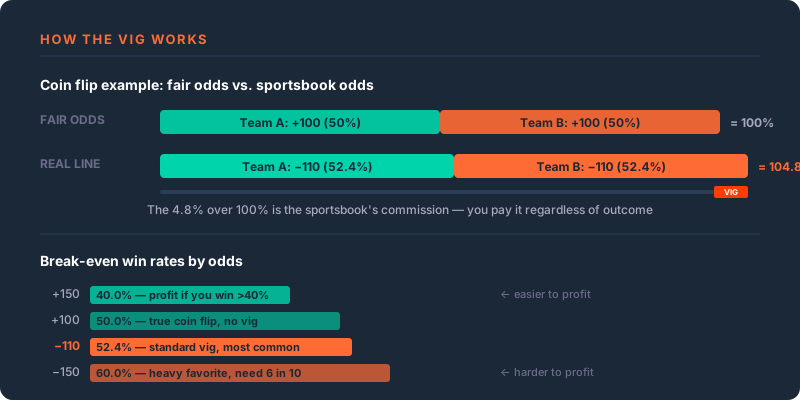
Every line carries a margin, and you can see it by adding up the implied probabilities. They always exceed 100% — and the overage is what the book keeps.
The vig in practice
| Standard line | Implied probability | Combined | Vig |
|---|---|---|---|
| Both sides at −110 | 52.4% + 52.4% | 104.8% | ~4.5% |
| Favorite −150 / Underdog +130 | 60% + 43.5% | 103.5% | ~3.4% |
| Favorite −200 / Underdog +170 | 66.7% + 37% | 103.7% | ~3.6% |
Break-even win rates
| Odds on each bet | Win rate needed to break even |
|---|---|
| −110 | 52.4% |
| −120 | 54.5% |
| −150 | 60.0% |
| +100 | 50.0% |
| +150 | 40.0% |
What this means for your wallet: at −110, if you win at a coin-flip 50% rate over time, you’d lose about $4.50 for every $100 wagered. That’s the vig doing its quiet work.
Key terms
- Vig (vigorish, juice)
- The book’s built-in commission on every bet. At −110 odds it works out to about 4.5%. It’s why winning half your bets still loses money.
- Moneyline
- A bet on who wins, with no point spread. Payouts vary based on each side’s odds.
- Spread
- A margin of victory the book sets. The favorite has to win by more than the spread to cover; the underdog gets a head start.
- Implied probability
- The chance of an outcome as suggested by the odds. Add up every outcome in a market and it tops 100% — the overage is the vig.
- Parlay (accumulator)
- One bet stacking several picks. All must win. Payouts grow with each leg — and so does the margin.
- Line
- The current odds and spread on a game. When sharp money moves, the line moves with it.
- Sharp
- A professional or highly informed bettor. When sharps act, books often adjust the line in response.
Tips for informed play
- Know the vig before you bet. At −110 you need 52.4% to break even. Learn the break-even rate for any odds you’re taking — it reframes every line.
- Shop the line. Odds vary between books. Comparing them is the single easiest way to shrink the vig — a half-point or ten cents adds up across hundreds of bets.
- Know what a parlay actually costs. The margin compounds per leg. Treat parlays as entertainment, not a strategy to beat the book.
- Set your bankroll and bet size. A common guideline is 1–3% of your total bankroll per bet — enough room to let any edge play out, and a buffer against losing streaks.
- The line already knows what you know. Books price in vast data and a near-efficient market. Beating it means finding what the market missed — which is genuinely hard.
Common myths
“Knowing the sport means I’ll win.”
The line already knows. Books set odds with more data than any individual — your knowledge of the game is already priced in. An edge means finding what the market missed.
“Parlays are a smart way to bet.”
The vig compounds with every leg. A 10-leg parlay hits roughly 1 in 1,024 at even odds — and the margin grows with each selection. Great fun, lousy math.
“Live betting gives me an edge.”
In-play odds move in seconds, set by algorithms processing data faster than any human. The in-play vig is often the widest on the board. Speed isn’t on your side here.
52.4%. That’s the win rate −110 odds demand just to stay flat. Everything else — line shopping, bankroll discipline, skipping the parlay — is about getting and staying on the right side of it.