Video poker hides one of the best deals on the casino floor behind a slot-machine cabinet. Deal five cards, decide which to keep, draw replacements — and unlike a slot, every one of those decisions has a mathematically correct answer that moves the math in your favor. The whole game comes down to two things: knowing the right holds, and reading the paytable before you sit down. To explore it hands-on, see the live interactive video poker guide. For how this compares to everything else, see the Game Guides index.
You’re dealt five cards, you choose which to hold, and the machine draws replacements. With optimal strategy on a full-pay Jacks or Better machine, the house edge drops to about 0.46% — one of the lowest in the casino. The catch: the paytable varies from machine to machine, and a worse paytable means worse odds. Check it before you play.
How the game works
Video poker looks like a slot machine. It isn’t. A slot’s random number generator could produce any result from any combination of symbols. Video poker deals from a standard 52-card deck (or 53 with a joker). The probabilities are the same as a physical deck — and your decisions about which cards to hold change the math. That hold/draw moment is what separates it from every other electronic game on the floor.
- Set your bet. Choose how many credits to wager per hand — typically 1 to 5. Why that matters is just below.
- Press deal. The machine deals five cards from a freshly shuffled deck.
- Choose which cards to hold. This is where the game lives. Keep the cards you want, discard the rest.
- Press draw. The machine replaces your discards with new cards from the same deck.
- Get paid. If your final five-card hand matches a winning combination on the paytable, you win. If not, the bet is lost.
Common variants
A few variants top 100% RTP with perfect play — which doesn’t mean free money. Those machines are rare, the strategy is demanding, and the swings are large.
| Variant | Key difference | Typical full-pay RTP |
|---|---|---|
| Jacks or Better | The standard. A pair of jacks or higher wins. | 99.54% |
| Deuces Wild | All 2s are wild. Minimum winning hand is three of a kind. | 100.76% (full-pay) |
| Bonus Poker | Higher payouts on four-of-a-kind hands. | 99.17% |
| Double Bonus Poker | Even bigger four-of-a-kind bonuses, lower pair payouts. | 100.17% (full-pay) |
| Joker Poker | Uses a 53-card deck with one joker as wild. | 100.64% (full-pay) |
Bet types
Video poker doesn’t have multiple bet types the way table games do. What you control is the size of your wager — and one of these settings quietly affects your odds.
| Setting | What it means | What it affects |
|---|---|---|
| Credits per hand | How many credits you wager (1–5). | Win size — payouts multiply by credits bet. |
| Coin denomination | The dollar value of each credit ($0.25, $0.50, $1.00…). | Sets the scale of every bet, win, and loss. |
| Max bet (5 credits) | Wagers the maximum credits per hand. | Usually required for the full royal-flush payout. |
On most machines the royal-flush payout jumps disproportionately at 5 credits. A 1-credit royal might pay 250; a 5-credit royal pays 4,000 — not 1,250. That bonus is a real chunk of the game’s RTP, so playing fewer than 5 credits quietly raises the house edge. If 5 credits at $1 is too rich, drop to a $0.25 machine and play max there.
The math
Every machine has a paytable that sets its RTP, and two machines sitting side by side can carry identical graphics with completely different math. The shorthand “9/6” refers to the full-house and flush payouts — the fastest way to compare machines. Every step down costs you.
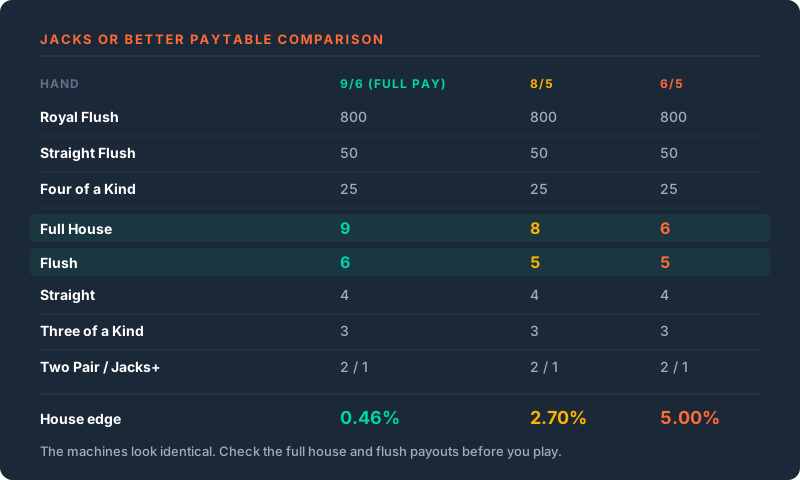
Same game, different math
The two numbers that matter on a Jacks or Better machine are the full-house and flush payouts.
| Jacks or Better paytable | Full house / Flush | RTP | House edge |
|---|---|---|---|
| Full-pay (9/6) | 9-for-1 / 6-for-1 | 99.54% | 0.46% |
| 8/5 | 8-for-1 / 5-for-1 | 97.30% | 2.70% |
| 7/5 | 7-for-1 / 5-for-1 | 96.15% | 3.85% |
| 6/5 | 6-for-1 / 5-for-1 | 95.00% | 5.00% |
What this means for your wallet: on a full-pay 9/6 machine you’d lose about 46 cents per $100 over time. Drop to a 6/5 machine and that same $100 costs you $5 — more than ten times as much, for a game that looks identical.
Basic strategy
Strategy is the set of mathematically optimal hold/discard decisions for every hand. Like blackjack basic strategy, it was solved by computing the expected value of every combination — it’s not a hunch, it’s the math. For Jacks or Better, hold the best available combination in this priority order (a simplified version of the full chart):
| Priority | Hand to hold | What to do |
|---|---|---|
| 1 | Royal flush, straight flush, four of a kind | Hold all five. |
| 2 | Four to a royal flush | Hold K-Q-J-10 suited, discard the fifth. |
| 3 | Full house, flush, straight | Hold all five. |
| 4 | Three of a kind | Hold the three, discard two. |
| 5 | Two pair | Hold both pairs, discard one. |
| 6 | High pair (jacks or better) | Hold the pair, discard three. |
| 7 | Four to a flush | Hold the four, draw one. |
| 8 | Low pair (tens or below) | Hold the pair, discard three. |
| 9 | Two suited high cards | Hold the two, discard three. |
| 10 | One high card (J, Q, K, A) | Hold one, discard four. |
- A low pair beats a single high card — a pair of 4s has more EV than a lone ace.
- Break a made flush to draw four-to-a-royal — the royal draw has higher expected value.
- Bring a strategy card. You can use one at the machine; nobody minds.
- Never hold a kicker. With a pair of queens and an ace, hold the pair only.
- Don’t play on gut feeling — every hold has a correct answer.
- Don’t assume the chart carries over: Deuces Wild and Bonus Poker have their own holds.
Key terms
- Paytable
- The chart on the machine showing what each winning hand pays. Two machines with the same name can carry different paytables — and different odds.
- Full-pay
- A machine with the best available paytable for its variant. For Jacks or Better, that’s 9/6: 9-for-1 on a full house, 6-for-1 on a flush.
- Short-pay
- Any paytable below full-pay. An 8/5 Jacks or Better is the same game with worse math.
- Hold / Draw
- Keep the cards you select (hold) and replace the rest (draw). Your only decision point — and the entire game.
- Royal flush
- A-K-Q-J-10 of one suit. The top payout, typically 800-for-1 at max bet. Hits roughly once every 40,000 hands with optimal play.
- Kicker
- An unpaired high card held next to a pair. Never hold one — it cuts your draws without improving expected value.
- Expected value (EV)
- The mathematical average outcome of a decision over endless repetitions. Strategy charts are built by comparing the EV of every possible hold.
Tips for informed play
- Check the paytable before you sit down. Look at the full-house and flush payouts. On Jacks or Better, 9/6 is full-pay. Anything less costs real money — and the machine won’t warn you.
- Play max credits if you can afford the denomination. The 5-credit royal bonus is a meaningful slice of the RTP. Too rich at $1? Find a $0.25 machine and play max there.
- Learn the strategy for your variant. Cards exist for every game and you can use them at the machine. Twenty minutes of study cuts the edge significantly.
- Don’t treat it like a slot. Every hold has a mathematically correct answer. Playing on a hunch leaves money on the table.
- Set your session budget. At a moderate 200–400 hands per hour and $1.25 a hand ($0.25 × 5 credits), that’s $250–$500 an hour in total wagers. Know the pace before you start.
Common myths
“It’s basically a slot with cards.”
In slots, the result is fixed the instant you press spin. In video poker, your hold decisions change the math — optimal play on Jacks or Better cuts the edge to 0.46%, versus 2–5% without.
“This machine is due for a royal.”
Machines don’t keep score. Each hand is dealt fresh from a shuffled deck. A royal hits about once in 40,000 hands on average — not on a schedule, and never because one is “overdue.”
“Two machines named the same are the same.”
A 9/6 and a 6/5 Jacks or Better look identical — same name, same buttons. The only difference is two numbers on the paytable, and it’s the gap between a 0.46% edge and a 5% one.
Find a full-pay machine, learn the holds, play max credits. Do those three things and you’re playing one of the smartest games in the building — with a cheat sheet you’re allowed to bring.