Roulette looks like a game of intricate choices: dozens of bets, a busy layout, electronic boards tracking every result. But no bet you place changes the odds. The one decision that moves the math is the wheel itself. This guide covers how a round works, what each bet pays, and why that single green pocket is the whole story. To explore it hands-on, try the live interactive roulette guide. For the full set of games, see the Game Guides index.
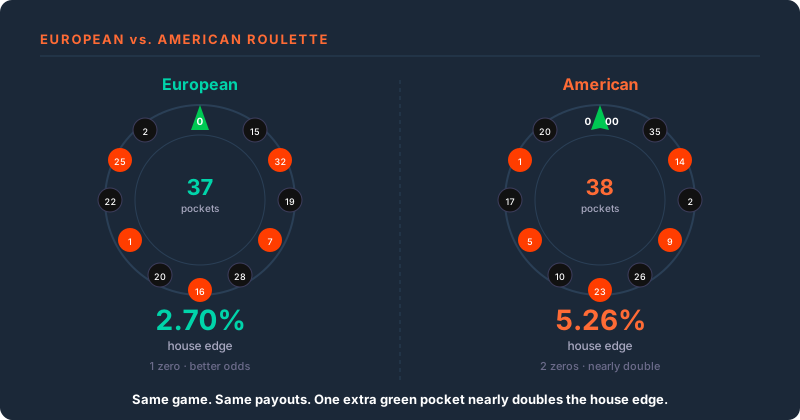
A ball lands on a random number, and you win if you bet on that number or a group containing it. No decision you make changes the odds. The only choice that matters is which wheel you play: European (one zero, 2.70% house edge) or American (two zeros, 5.26%). That single extra zero nearly doubles the house's advantage.
How the game works
The wheel
A roulette wheel has numbered pockets where the ball can land — 1 through 36, alternating red and black, plus one or two green zeros. Those green zeros are what give the house its edge. Without them, every bet would be perfectly fair.
| Wheel type | Pockets | Zeros | Numbers |
|---|---|---|---|
| European | 37 | Single zero (0) | 0–36 |
| American | 38 | Double zero (0, 00) | 0, 00, 1–36 |
| French | 37 | Single zero with la partage / en prison | 0–36 |
Playing a round
- Place your betsPut chips on the layout — on numbers, groups, colors, or other options. You can place several bets at once.
- The dealer spins the wheelThe croupier launches the ball in the opposite direction to the spin.
- "No more bets"Called when the ball is about to drop. After this, no chips can be placed or moved.
- The ball landsIt settles into a numbered pocket. That number and its color are the result.
- PayoutsThe dealer clears losing bets and pays winners, based on the type of bet placed.
Every spin is independent. The wheel doesn't remember previous results, and the boards showing "hot" and "cold" numbers are for entertainment — they have zero predictive value.
Bet types
Inside bets
Placed directly on specific numbers. Higher risk, higher payout.
| Bet | What it means | Payout | Numbers covered |
|---|---|---|---|
| Straight up | A single number | 35:1 | 1 |
| Split | Two adjacent numbers | 17:1 | 2 |
| Street | Three numbers in a row | 11:1 | 3 |
| Corner | Four numbers sharing a corner | 8:1 | 4 |
| Six line | Two adjacent rows | 5:1 | 6 |
Outside bets
Placed on larger groups. Lower risk, lower payout.
| Bet | What it means | Payout | Numbers covered |
|---|---|---|---|
| Red / Black | The winning number's color | 1:1 | 18 |
| Odd / Even | Whether the number is odd or even | 1:1 | 18 |
| High / Low | 1–18 (low) or 19–36 (high) | 1:1 | 18 |
| Dozens | First, second, or third group of 12 | 2:1 | 12 |
| Columns | One of three vertical columns | 2:1 | 12 |
Every bet on a standard roulette table carries the same house edge — single number or red/black, it's calibrated to be identical. The lone exception is the five-number bet (0, 00, 1, 2, 3) on American roulette, which jumps to a 7.89% edge. It's the worst bet on the table; skip it.
The math: the zero makes the difference
The house edge comes straight from the green pockets. Take a straight-up bet on a European wheel: you pick one number out of 37 pockets, so your real chance of winning is 1 in 37 (about 2.70%). But the payout is 35:1 — as if there were only 36 pockets. That gap between the true odds and the payout odds is the house edge. On an American wheel it's 1 in 38 with the same 35:1 payout, so the gap is wider and the house keeps more.
| Wheel | House edge | Why |
|---|---|---|
| European (single zero) | 2.70% | 37 pockets, payouts based on 36. The zero is the house margin. |
| American (double zero) | 5.26% | 38 pockets, payouts still based on 36. Two zeros, nearly double the edge. |
| French (with la partage) | 1.35% | On even-money bets — land on zero and you get half your bet back. |
Key terms
- Inside bet
- A bet placed on specific numbers on the inside of the layout. Higher payouts, lower probability.
- Outside bet
- A bet on large groups — red/black, odd/even, dozens — on the outside of the layout. Lower payouts, higher probability.
- Zero (0)
- The green pocket that gives the house its edge. European wheels have one.
- Double zero (00)
- The second green pocket on American wheels. Nearly doubles the house edge.
- La partage
- A French rule: if the ball lands on zero, even-money bets lose only half. Cuts the edge to 1.35%.
- En prison
- A French rule: on a zero, even-money bets are "imprisoned" for the next spin. Win it and you get your bet back. Roughly the same edge reduction as la partage.
- Croupier
- The dealer at a roulette table — spins the wheel, calls the result, and handles bets and payouts.
Tips for informed play
- Check the wheel type before you play. European (one zero) has a 2.70% edge; American (two zeros) has 5.26%. If both are available, the math favors European every time.
- Look for la partage or en prison. If a table offers French rules on even-money bets, the house edge drops to 1.35% — the lowest in roulette.
- Know that every spin is independent. The ball landed on red five times in a row? The odds on the next spin are exactly the same. Scoreboards of past results are entertainment, not information.
- Skip the five-number bet on American roulette. The bet covering 0, 00, 1, 2, 3 carries a 7.89% house edge — the worst on the table.
- Set your budget per session. Roulette runs at a moderate pace — about 30–40 spins per hour at a physical table, faster online. Decide what the session is worth as entertainment before you start.
Common myths
The ball doesn't remember where it landed last time. Three places that idea leads players astray.
Myth
Red is "due" after a streak
Every spin is independent. The ball landed on black eight times in a row? The odds on the next spin are exactly the same. The wheel has no memory.
Myth
"Hot number" boards predict the next spin
Those electronic scoreboards are decoration. They show past results, which have zero predictive value. They exist to entertain, not to inform.
Myth
Picking "your" numbers improves your odds
The ball does not know you, your birthday, or your lucky digits. Every number has the same chance every spin — and a betting system on top of that changes nothing.
You can't out-think a roulette wheel, but you can pick a good one. Find the single-zero European wheel (or French rules if you can), set your session budget, and enjoy the spin. One zero or two — that's the only decision that matters.