Slots are the most-played game on any casino floor and the easiest to misread. The flashing reels look like a story unfolding; they are really just an animation of a decision that was already made. This guide covers the mechanics, the real numbers, and the handful of choices that are genuinely yours. To explore it hands-on, see the live interactive slots guide. For the full set of games, see the Game Guides index.
You press a button, a random number generator picks the outcome, and the reels display the result. There is no strategy that changes the math. The house edge ranges from 2% to 15% depending on the machine. Check the paytable before you play — it takes 30 seconds and tells you everything the machine won't.
How the game works
Every modern slot — a physical cabinet on the floor or a game on your phone — runs on a random number generator (RNG). The RNG produces a random result the instant you hit spin. The spinning reels are just the show. Here is what happens on a single spin.
- Choose your betYou set two things: how many paylines to activate and how much to bet per line. Your total bet is lines times bet-per-line.
- Press spinThe RNG generates a random number the instant you hit the button. That number maps to a specific combination of symbols.
- Reels display the resultThe animation plays out — but the outcome was already decided before the reels started moving.
- Wins are paid automaticallyIf symbols on an active payline match a winning combination in the paytable, you get paid. If not, the bet is lost.
Bonus features
Many modern slots layer extra mechanics on top of the base game. None of them change the underlying randomness.
Free spins
Land a set number of scatter symbols and you get extra spins at no cost. The game still uses the same RNG.
Bonus rounds
A separate screen with a pick-a-prize or wheel-spin mechanic. Still RNG, still random.
Progressive jackpots
A slice of every bet feeds a shared pool that grows until someone wins. Odds of hitting run roughly 1 in 1 million to 1 in 50 million.
Bet types: what you actually control
Slots don't have bet types the way table games do. What you control is the size of your bet — and a few settings that change how the session feels.
| Setting | What it means | What it affects |
|---|---|---|
| Bet per line | The amount wagered on each active payline | Win size — payouts are multiplied by your bet per line |
| Number of lines | How many paylines are active this spin | Win frequency — more lines, more chances to match, higher total bet |
| Max bet | Activates all paylines at maximum bet per line | Required for some progressive jackpots — check the paytable |
| Coin denomination | The base value of each credit ($0.01, $0.25, $1.00) | Sets the scale of everything — bets, wins, and losses |
Betting more per spin does not improve your odds. The house edge is a percentage — it applies equally whether you bet $0.25 or $25. Bigger bets simply scale the wins and the losses up together, at the same rate.
The math: RTP, house edge, and volatility
Every slot has a programmed return to player (RTP) — the percentage of all money wagered that the machine pays back over its lifetime. The house edge is whatever is left over. These numbers are set in the game software and regulated by gaming authorities.
| Metric | Typical range | What it means |
|---|---|---|
| RTP | 85–98% | For every $100 wagered in total, the machine pays back $85 to $98 |
| House edge | 2–15% | The casino's cut — what the machine keeps |
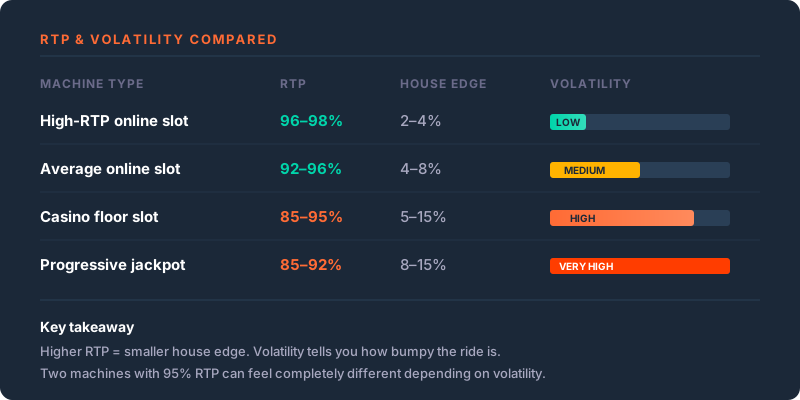
Most online slots sit in the 92–97% RTP range; physical casino machines tend to run 85–95%. So a slot with 95% RTP carries a 5% house edge: for every $100 you bet over time, you'd lose about $5 on average. That is the long-run math — any single session can swing wildly in either direction.
Volatility: same math, different ride
RTP tells you the long-run average. Volatility tells you what the ride feels like. Two machines can share the same 95% RTP and still play completely differently.
Low volatility
Frequent small wins, fewer dry spells
Steady — your balance changes slowly
Medium volatility
A mix of small and medium wins
Balanced — some swings, some stability
High volatility
Rare but larger wins, longer losing streaks
Roller coaster — long droughts, then big hits
Key terms
- RNG (random number generator)
- The software that produces a random outcome for every spin. It runs continuously, even when nobody is playing.
- RTP (return to player)
- The percentage of total money wagered that a machine pays back over its lifetime. A 95% RTP means a 5% house edge.
- Payline
- A line across the reels where matching symbols must land to count as a win. Modern slots can have 1 to 1,000+ paylines.
- Paytable
- The chart showing every winning combination and its payout. Usually one tap away via an info button on the machine.
- Scatter
- A symbol that triggers a bonus (usually free spins) regardless of where it lands — it does not need to sit on a payline.
- Wild
- A symbol that substitutes for others to complete winning combinations. Works like a joker in cards.
- Volatility
- How a slot distributes its payouts. Low means frequent small wins; high means rare big ones. Also called variance.
- Progressive jackpot
- A prize pool that grows with every bet across linked machines, then resets to a base amount after someone wins.
Tips for informed play
You can't change the odds, but you can decide which machine to sit at and how long your money lasts.
- Check the paytable before you play. It takes 30 seconds and shows the RTP, payline structure, and what triggers bonuses. If a machine doesn't show its RTP, that's worth knowing too.
- Understand "max bet required." Some progressive jackpots only pay if you're betting the maximum. If you're not going to max bet, a non-progressive machine gives every bet the same proportional chance.
- Pick your volatility, not your theme. Two cartoon-themed machines can play completely differently. Low volatility stretches your session; high volatility creates bigger swings. Neither is better — they're different experiences.
- Set your budget before you press spin. Slots move fast: a $0.50 bet every 3 seconds adds up to about $600 per hour, even on a "penny" machine.
- Know that every spin is independent. What happened on the last spin — or the last 1,000 — has zero effect on the next one. The RNG doesn't keep score.
Common myths
Three of the most common slot misconceptions, and what's actually happening inside the cabinet.
Myth
The machine is "due" for a win
Machines do not keep score. A slot that has not paid in 30 minutes has exactly the same odds on the next spin as one that just hit a jackpot. Believing otherwise is the gambler’s fallacy.
Myth
A "lucky machine" pays out for you
That is confirmation bias, not loyalty. The RNG has no memory of who is sitting there. Your "lucky machine" has the emotional range of a toaster.
Myth
Higher bets improve your odds
The house edge is a percentage — it applies equally whether you bet $0.25 or $25. Bigger bets mean bigger potential wins and bigger potential losses at the same rate.
The paytable is the most useful button on the machine. It shows the RTP, paylines, and bonus triggers — everything the flashy animation doesn't tell you. Read it, pick your volatility, set your budget, and the rest is the ride.