Most casino games are pure chance. Blackjack isn't. The choices you make — hit, stand, double, split — change the math in real time, which is exactly why it rewards a little homework. This guide covers the rules, the decisions that matter, and the single 20-minute investment that separates the best odds in the casino from average ones. You can also walk through it in the live interactive blackjack guide. For the full set of games, see the Game Guides index.
You try to get closer to 21 than the dealer without going over. You make decisions — hit, stand, double, split — that genuinely affect the outcome. With basic strategy, the house edge drops to about 0.5%, the best odds in the casino. Without it, the edge climbs to 2% or more.
How the game works
Card values
Number cards (2–10) count at face value. Face cards (J, Q, K) count as 10. An ace counts as 1 or 11 — whichever helps your hand more. A hand using an ace as 11 is called a "soft" hand (Ace + 6 = soft 17). It's soft because you can't bust on the next card: the ace can quietly switch to 1.
Playing a hand
- Place your betSet your wager before any cards are dealt.
- Receive two cardsYou get two cards face up. The dealer gets one card face up (the "upcard") and one face down (the "hole card").
- Check for blackjackIf your first two cards total 21 — an ace plus a 10-value card — that is a blackjack. You win automatically at 3:2, unless the dealer also has one (a push).
- Make your decisionsBased on your hand and the dealer’s upcard, choose from the available actions: hit, stand, double, split, surrender.
- Dealer playsAfter all players finish, the dealer reveals the hole card and follows fixed rules — typically hitting until reaching 17 or higher.
- Compare totalsCloser to 21 wins. Going over 21 (busting) is an automatic loss. Ties (pushes) return your bet.
The dealer follows a script
The dealer has no choices. No doubling, no splitting, no surrender — just a fixed set of rules: hit on 16 or below, stand on 17 or above. (Some tables require the dealer to hit on "soft 17," which nudges the house edge up slightly.) Every decision at the table is yours; the dealer just executes.
Bet types
| Bet | What it means | Payout | House edge |
|---|---|---|---|
| Base bet | Your main wager on the hand | 1:1 (even money) | 0.5%–2%+ |
| Blackjack | Natural 21 on the first two cards | 3:2 (or 6:5 at some tables) | — |
| Insurance | Side bet that the dealer has blackjack | 2:1 | ~7.7% |
| Side bets (Perfect Pairs, 21+3) | Bets on specific card combinations | 5:1 to 100:1+ | 2%–11%+ |
Some tables pay 6:5 on a natural blackjack instead of 3:2. On a $10 bet, that's $12 instead of $15 — and this single rule change raises the house edge by about 1.4%. Insurance and most side bets are worse still: at a ~7.7% edge, basic strategy says skip insurance every time. Check the table sign before you sit down.
The math
Blackjack's house edge isn't one number — it swings with the rules and, above all, with whether you play basic strategy. Get both right and you're as close to a coin flip as a casino allows.
| Scenario | House edge |
|---|---|
| Basic strategy, favorable rules (3:2, stand on soft 17, 6 decks) | ~0.5% |
| Basic strategy, standard rules | ~0.6–0.8% |
| Average player (no basic strategy) | ~2–2.5% |
| 6:5 payout table (even with basic strategy) | ~1.5–2% |
With basic strategy at a standard table, the edge is about 0.5%: for every $100 you bet over time, you'd lose about 50 cents on average. Without it, that climbs to roughly $2–$2.50 per $100. The gap between knowing basic strategy and not knowing it is the gap between the best odds in the casino and average ones — and the strategy itself takes about 20 minutes to learn.
Basic strategy
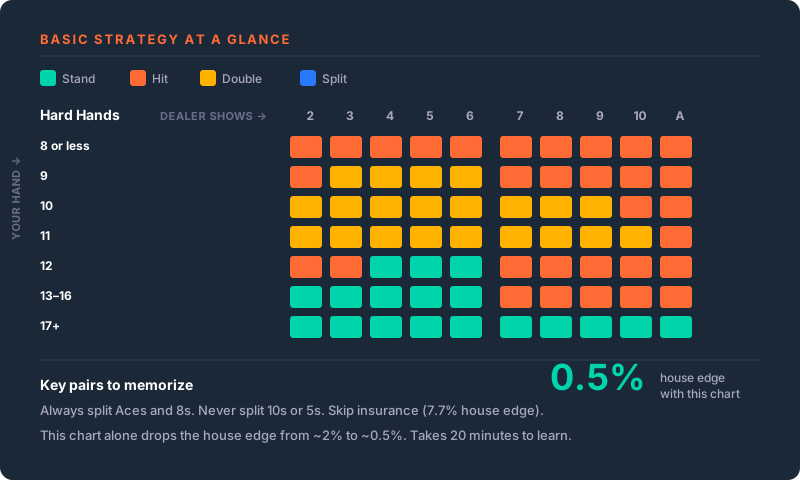
Basic strategy is the mathematically optimal decision for every possible hand. It was worked out by running millions of simulated hands through computers — it's not a "system" or a "trick," just the math. Your move depends on your hand total and the dealer's upcard.
Hard hands
Stand on 17 and up. Stand on 12–16 when the dealer shows 2–6, but hit when the dealer shows 7 through ace. Double 11 (and usually 10 and 9 versus weak dealer cards).
Soft hands
Soft 19+ stands. Soft 18 stands against a weak dealer card but hits against 9, 10, or ace. Lower soft totals hit, and double against the dealer's 5 and 6.
Pairs
Always split aces and 8s. Never split 10s (you already have 20) or 5s (treat as a 10 and double). Everything else depends on the dealer's upcard.
This is the simplified version. Exact strategy shifts slightly with deck count and table rules — full charts for every variation are widely available, and a quick web search turns up a printable one for the exact game you're playing.
Key terms
- Blackjack
- A hand totaling 21 with exactly two cards — an ace plus a 10-value card. Pays 3:2 at standard tables.
- Bust
- Going over 21. An automatic loss, regardless of what the dealer has.
- Double down
- Double your bet and receive exactly one more card. A commitment — you cannot hit again after.
- Push
- A tie. Your hand and the dealer’s have the same total, and your bet is returned.
- Shoe
- The dealing device that holds multiple decks. Most casino blackjack uses 6 or 8 decks.
- Insurance
- A side bet offered when the dealer shows an ace. Pays 2:1 if the dealer has blackjack — but carries a ~7.7% house edge.
- Soft hand
- A hand containing an ace counted as 11 (e.g., A-6 = soft 17). It cannot bust on the next hit.
- Hard hand
- A hand with no ace, or where the ace must count as 1 to stay under 21.
Tips for informed play
- Learn basic strategy. It takes about 20 minutes and cuts the house edge in half — the single most impactful thing you can do at the table. Free charts are everywhere.
- Check the table rules before you sit. Look for 3:2 blackjack (not 6:5), and check whether the dealer stands or hits on soft 17. These details change the math significantly.
- Skip insurance. At a ~7.7% house edge, the math doesn't support it. Basic strategy says decline it every time.
- Set your budget before you play. Decide on a session bankroll and a bet size. A common guideline: bet about 1–2% of your session budget, which gives you enough hands to let the strategy work.
- Don't worry about other players. The person next to you making a "bad" play doesn't affect your odds. Each hand plays out against the dealer independently.
Common myths
Three myths that quietly cost players money at the blackjack table.
Myth
Betting systems beat the house
The Martingale and its cousins feel clever but just delay the inevitable. No staking pattern changes the house edge — it changes how fast you reach your limit.
Myth
The dealer is hot or cold
The dealer has no choices. Hit below 17, stand at 17 or above. There is no streak to ride or avoid — just a script playing out.
Myth
Card counting is easy money
Counting gives a real but tiny edge, and only with serious effort, perfect play, and conditions casinos actively work to remove. For almost everyone, basic strategy is the real win.
Learn the chart, find a 3:2 table, decline insurance, and ignore the streaks. That's the best odds in the casino — earned in about 20 minutes.