Bingo feels social and a little superstitious, but underneath the daubers and lucky charms it is one of the most transparent games on the floor: a random draw, an equal chance for every card, and a house edge that sits in plain sight inside the prize pool. This guide covers the mechanics, the real numbers, and the handful of choices that actually move your odds. For the full set of games, see the Game Guides index.
Numbers are called, you mark them, and the first player to complete the pattern wins. Every card in the game has the same chance — the draw does not care which one you are holding. The house edge comes from the gap between total card sales and total prizes paid out; the operator keeps the difference, typically 5% to 25%. More cards give you more chances, and cost you proportionally more.
How the game works
A caller draws numbers at random — physical ball machines in venues, certified random number generators online — and you daub the matches on your card. The first player to complete a specific pattern wins. That is the whole game. Here is a single session, start to finish.
- Buy your cardsEach card holds a grid of randomly arranged numbers. In a room of 100 players, every card has the same chance of winning. Buy more cards for more chances.
- Listen for the callNumbers are drawn one at a time, at random — a caller in a venue, on-screen draws online. Every number has an equal chance of coming up.
- Daub your matchesWhen a called number appears on your card, you mark it. Online, auto-daub does it for you so you never miss one.
- Complete the patternThe first player to finish the required pattern — a line, a shape, or a full house — wins. Call "Bingo" in a venue, or the system detects it online.
- Prize is awardedIf two players complete the pattern on the same call, the prize is typically split equally between them.
The three common formats
The grid and the winning patterns change by format, but the underlying draw is identical — random, and equal for every card.
75-ball (US standard)
5×5 grid with a free center square. Numbers 1–75, sorted by column: B (1–15), I (16–30), N (31–45), G (46–60), O (61–75).
Patterns Single line, four corners, X-pattern, or full card (blackout).
90-ball (UK / international)
9×3 grid with 15 numbers and 12 blanks per card. Numbers 1–90.
Patterns Three stages, three prizes: one line, two lines, then full house.
Speed / 30-ball
3×3 grid, 9 numbers. Fast rounds, usually online.
Patterns Full house only — first to fill the card wins.
Bet types: what you are buying
In bingo, your "bet" is how many cards you hold and which game you join. More cards mean more chances — at a proportionally higher cost. Side games are a separate product entirely.
| Type | What it means | Typical cost | What it gets you |
|---|---|---|---|
| Single card | One card for one game | $0.25–$3 per card | One chance to win that game |
| Multi-card | Several cards for one game | Per-card price × quantity | More chances, proportionally higher cost |
| Card strips (90-ball) | A set of cards covering all 90 numbers | Varies by venue | You daub every number called — but so does everyone else with a strip |
| Progressive jackpot | A rolling jackpot won by a full house inside a set call limit (e.g. 50 calls or fewer) | $1–$5, premium card | Shot at a large jackpot — if the pattern lands inside the limit |
| Side games | Slots, instant wins, or mini-games running alongside bingo (mostly online) | Varies | Separate odds and RTPs from the main game — check each one |
Side games — the slots and instant-wins that run alongside online bingo — are not bingo. They carry their own RTPs, often lower than the main game. Treat each one as a separate decision and check its numbers before you play.
The math: house edge and the prize pool
Bingo's house edge is baked into the prize structure, not the draw. The draw is genuinely fair — every card has an equal chance. The operator's cut is simply the gap between what players pay for cards and what gets paid back in prizes.
The formula is straightforward: house edge equals total card sales minus total prizes, divided by total card sales. The same fair draw can run at very different margins depending on how the operator sets the payout.
| Setting | Total card sales | Total prizes | House edge |
|---|---|---|---|
| Community hall | $500 | $400 | 20% |
| Commercial bingo club | $10,000 | $8,500 | 15% |
| Online bingo room | $5,000 | $4,500 | 10% |
Online games typically run 5–15%; venue games run 10–25%. So at a 15% house edge, $100 spent on cards returns about $85 in prizes over time. That is the long-run average — any single session you might win big, win nothing, or land somewhere between.
Card-quantity math
Buying more cards improves your odds of winning in a straight line — but it never changes the house edge. If 100 cards are in play and you hold a slice of them, your win probability is simply your share.
| Cards in the room | Your cards | Your win probability | Your cost |
|---|---|---|---|
| 100 | 1 | 1% | $1 |
| 100 | 5 | 5% | $5 |
| 100 | 10 | 10% | $10 |
| 100 | 50 | 50% | $50 |
Your odds rise linearly with each card — but so does your spend. The expected return per dollar stays exactly the same.
Key terms
- Caller
- The person — or automated system — that draws and announces each number.
- Daub (mark, dab)
- To mark a called number on your card. Online, auto-daub does this for you.
- Full house (blackout, coverall)
- Completing every number on your card. The biggest standard prize in most formats.
- Line
- A completed row — horizontal, vertical, or diagonal, depending on the format. Often the first prize of a game.
- Pattern
- The exact arrangement of marked numbers needed to win: a line, an X-shape, four corners, a full house.
- Auto-daub
- An online feature that marks called numbers automatically, so you never miss one.
- Progressive jackpot
- A prize pool that grows until someone hits a full house inside a set number of calls, then resets.
- Free space (75-ball)
- The center square on a 75-ball card. It is marked automatically — everyone starts with it.
Tips for informed play
You cannot change a fair draw, but you can pick your session, manage your cards, and know where the real odds live.
- Set your per-session budget first. More cards means more chances and more cost. Decide your spend before you buy, not mid-session — a "just one more strip" habit adds up fast.
- Remember the edge is in the prize pool, not the balls. The draw is fair; the operator's margin is the gap between card sales and prizes. That is the number that decides your long-run return.
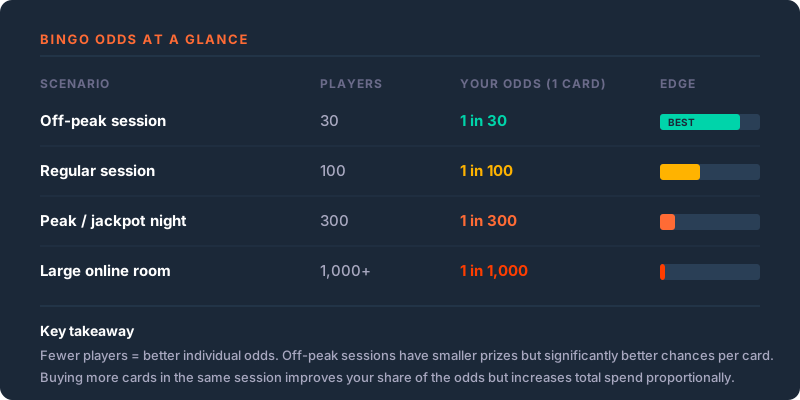
- Play off-peak for better odds per card. If 50 people play instead of 200, your one card goes from a 1-in-200 chance to 1-in-50. The prize pool may be smaller, but each game is more winnable.
- Check side games separately. The slots and instant-wins beside online bingo are their own products with their own — often lower — RTPs. They are not part of the bingo math.
- Use auto-daub, but know what it does. It does not improve your odds — it just stops you missing a win. In venues, play only as many cards as you can actually track.
Common myths
Three of the most common bingo misconceptions, and what is actually happening in the draw. For the wider playbook on correcting these without lecturing, see Myth-Busting.
Myth
Some seats win more
Where you sit has zero effect on a random draw. The balls do not know — or care — which chair you picked. Lucky seats are a story we tell, not a thing that exists.
Myth
That number is "due"
Every call is independent. The machine has no memory of what it pulled five minutes ago. A number that has not come up is exactly as likely as any other on the next draw.
Myth
Certain cards are luckier
Every card in a given game has an identical chance of completing the pattern first. The specific numbers printed on it do not matter — only how many cards are in play versus how many are yours.
Your odds in any bingo game come down to a single number: how many of the cards in play are yours. Last week's win, your lucky seat, and the "due" number are all noise. Pick your session, set your budget, and enjoy the draw for what it is. If the fun ever starts to slip, the National Council on Problem Gambling has free, confidential support.