The lottery sells the biggest dream in gambling for the smallest stake, and that trade is exactly why the math matters. Jackpot odds are astronomical, the return is the lowest of any mainstream game, and every "system" runs into the same wall: the draw is random. This guide lays out the real numbers in plain terms. For the full set of games, see the Game Guides index.
You pick numbers, a random draw picks numbers, and you hope they match. No skill, no strategy, no system changes the odds. Jackpot odds are extreme — often worse than 1 in 100 million. The overall return runs about 50–65%, which means the lottery keeps roughly 35% to 50% of every dollar wagered — the widest house edge in mainstream gambling. It is entertainment with a dream attached, not an investment.
How the game works
Lottery comes in two main shapes: scheduled draw games, where you wait for a random draw to match your numbers, and scratch cards, where the outcome was already decided when the card was printed. Here is a draw game, step by step.
- Buy a ticketYou pick a set of numbers from a defined range — or let the machine pick (quick pick / lucky dip). Most draws need numbers from two pools, e.g. 5 from 69 plus 1 from 26.
- Wait for the drawAt a scheduled time, the operator draws numbers using certified random methods — physical ball machines or audited random number generators.
- Check your numbersMatch the drawn numbers and you win. The more you match, the higher the prize. The jackpot needs all numbers, exactly.
- Collect across tiersMost lotteries pay smaller prizes for partial matches — three, four, or five numbers pays progressively more, even if you miss the jackpot.
Scratch cards (instant games)
Each card has a set price and a predetermined set of outcomes spread across the entire print run. You remove the coating to see your result — but the outcome was fixed at printing, so scratching is just the reveal. Every game publishes its prize structure and odds, usually on the back of the card.
Syndicates (group play)
A syndicate pools money to buy more tickets. More tickets means more chances to match — but any prize is split among all members. Your odds improve linearly (buy ten tickets, ten times the chance), and your share of any win shrinks by exactly the same factor.
Bet types: what you can buy
Every option below buys the same underlying thing — a chance in a random draw. Quick picks and self-picked numbers have identical odds; multi-draws and add-ons change convenience or secondary prizes, not the headline jackpot chance.
| Type | What it means | Typical cost | What it gets you |
|---|---|---|---|
| Single ticket | One set of numbers for one draw | $1–$5 per ticket | One chance at each prize tier |
| Multi-draw | Same numbers entered across several future draws | $1–$5 × number of draws | Convenience — no rebuying the same numbers |
| Quick pick | Machine-selected random numbers | Same as a single ticket | Mathematically identical odds to self-picked numbers |
| Syndicate share | A share of a group ticket purchase | Varies by syndicate size | More combinations covered; any prize split proportionally |
| Scratch card | Instant-reveal game with predetermined outcomes | $1–$30 per card | Immediate result — no waiting for a draw |
| Add-on games | Secondary draws or multipliers on a base ticket (Power Play, Megaplier) | $1–$3 extra | Multiplies non-jackpot prizes; changes the secondary-tier math |
The math: jackpot odds and return
Two numbers tell the whole story: the odds of hitting the jackpot (always extreme), and the return to player, or RTP (always low). The lottery keeps the rest — some funds prizes, some funds the operator, and depending on your jurisdiction, some goes to government programs or good causes.
Jackpot odds
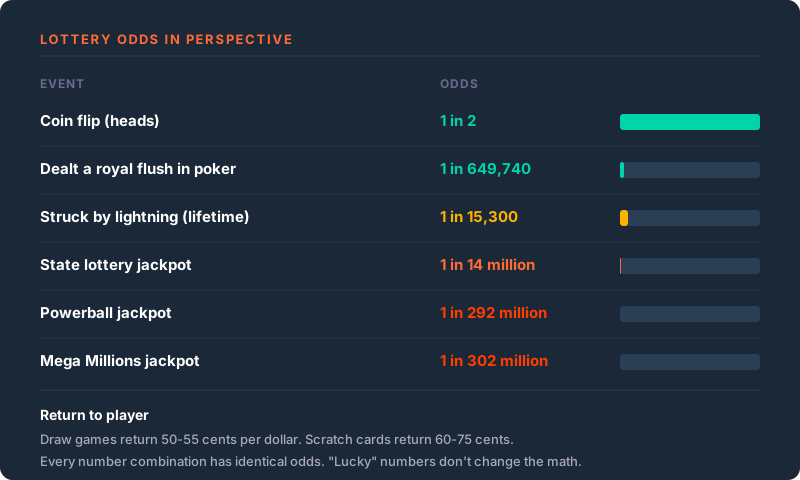
The odds depend on the game format, but they are always extreme. The bigger the jackpot, the longer the odds.
| Game type | Typical jackpot odds | For perspective |
|---|---|---|
| Major national draw (6 from 49) | ~1 in 14 million | About the odds of flipping heads 23 times in a row |
| Multi-state / national draw (5+1) | 1 in 100M to 1 in 300M | You are more likely to be struck by lightning twice |
| Smaller state / regional draw | 1 in 1M to 1 in 10M | Better, but still astronomically unlikely |
Return to player
For comparison: most casino table games return 95–99%, and slots return 85–98%. The lottery sits well below both.
| Product | Typical RTP | What it means |
|---|---|---|
| Major draw games | 50–55% | For every $100 in tickets, about $50–$55 comes back as prizes |
| Scratch cards | 60–75% | Better than draws, but still well below casino games |
| Add-on multipliers | Varies | Can improve or worsen RTP depending on the product |
Put plainly: for every $100 you spend on tickets, you would expect about $50–$65 back over time. Scratch cards vary more than draws — each game publishes its own odds and prize distribution, and higher-priced cards often (but not always) return slightly more. Always check two different numbers: the odds of winning something versus winning enough to cover the ticket.
Key terms
- Draw
- The event where winning numbers are randomly selected — physical ball machines or a certified RNG.
- Jackpot
- The top prize, usually requiring all numbers to match. Often rolls over if not won, growing the pool.
- Rollover
- When no one wins the jackpot, the money carries forward to the next draw, increasing it.
- Syndicate
- A group of players who pool money to buy more tickets and split any winnings proportionally.
- Quick pick (lucky dip)
- A ticket where the machine picks the numbers for you instead of you choosing them.
- Scratch card (instant game)
- A ticket with a predetermined outcome revealed by scratching. The result is set at printing, not at purchase.
- Annuity vs. lump sum
- Two ways to take a big jackpot: annuity pays over 20–30 years; lump sum is a single reduced payment, typically 40–60% of the advertised figure.
- Print run
- The total number of scratch cards made for a game. Prizes are spread across the whole run.
Tips for informed play
You cannot improve a random draw, but you can know exactly what you are buying before you buy it.
- Every combination has identical odds. Birthdays, "lucky" numbers, patterns, and quick picks all share the same probability. The balls do not know which numbers you picked, or why.
- Syndicates redistribute, they do not create value. Ten tickets as a group is ten times the chance and a ten-way split. The math is honest — just know that a shared win is a smaller win.
- Check scratch-card odds before you buy. The back of the card or the lottery website shows the overall odds and prize breakdown. Two cards from the same game at the same price can differ depending on how many top prizes remain.
- Budget it like entertainment, not investment. The RTP is 50–65%. Over time you will get back about half to two-thirds of what you spend. Decide what the dream is worth to you, and stick to it.
- "Systems" do not change the math. No analysis of past draws predicts future random draws — the draws are independent events. Anything sold as a winning system is selling hope.
Common myths
Three of the most common lottery misconceptions, and what is actually happening in the draw. For the playbook on addressing these in your own copy, see Myth-Busting.
Myth
"Lucky" numbers and birthdays beat the draw
Every combination has identical odds — the balls do not know your birthday. Worse, birthday numbers (1–31) are popular, so a low-number jackpot is more likely to be split. Picking less popular numbers will not help you win, but it can help you not share.
Myth
A number that has not come up is "due"
The gambler’s fallacy, in lottery form. Every draw is independent, with no memory of the last one. "Hot" and "cold" numbers are patterns the human brain invents — the draw stays random.
Myth
A system can pick winners
Software, books, and services that promise better lottery odds are selling hope, not probability. No analysis of past draws predicts a future random draw. Buying more tickets raises your chance linearly, but the expected return stays negative.
Roughly 75% of jackpots go to quick picks — not because the machine is lucky, but because about 75% of tickets sold are quick picks. It is proportion, not magic. Self-picked numbers have exactly the same odds per ticket.
The lottery is the most expensive entertainment in gambling and the one with the longest odds. That is fine — as long as you treat the ticket as the price of a daydream, not a plan. Know the number you are spending and enjoy the "what if." If it ever stops feeling like a daydream, the National Council on Problem Gambling offers free, confidential help.